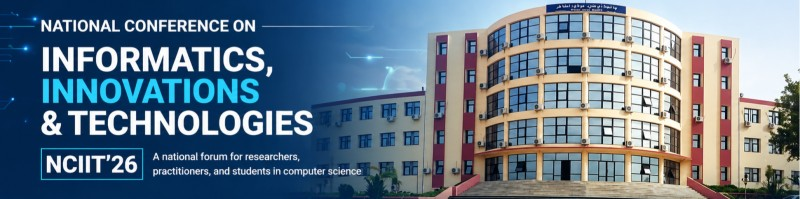

NCIIT'26 provides an excellent national forum designed to bring together researchers, delegates, students, and practitioners from both academia and industry. The conference creates a unique space to share cutting-edge developments across the full spectrum of computer sciences. Hosted at the University of Saida Dr Moulay Tahar, it fosters collaboration and advances scientific and educational activities in the field of informatics and emerging technologies.
Five domains at the heart of today's technologies.
Machine learning, deep learning, fuzzy logic.
Grid computing, load balancing, distributed systems.
Privacy preserving, IoT security.
Submissions open.
Originally May 31, 2026 → extended to June 30, 2026.
Originally June 15, 2026 → extended to July 24, 2026.
Each submission is reviewed by at least two program committee members.
All submissions must be written in English, original, and may not be under review elsewhere.
Submitted files must not contain any authors information.
Consult the IEEE manuscript submission guidelines. All papers in 6 pages.
Format your paper using the official IEEE templates before submitting.
Upload your paper to the NCIIT’26 Microsoft CMT platform.
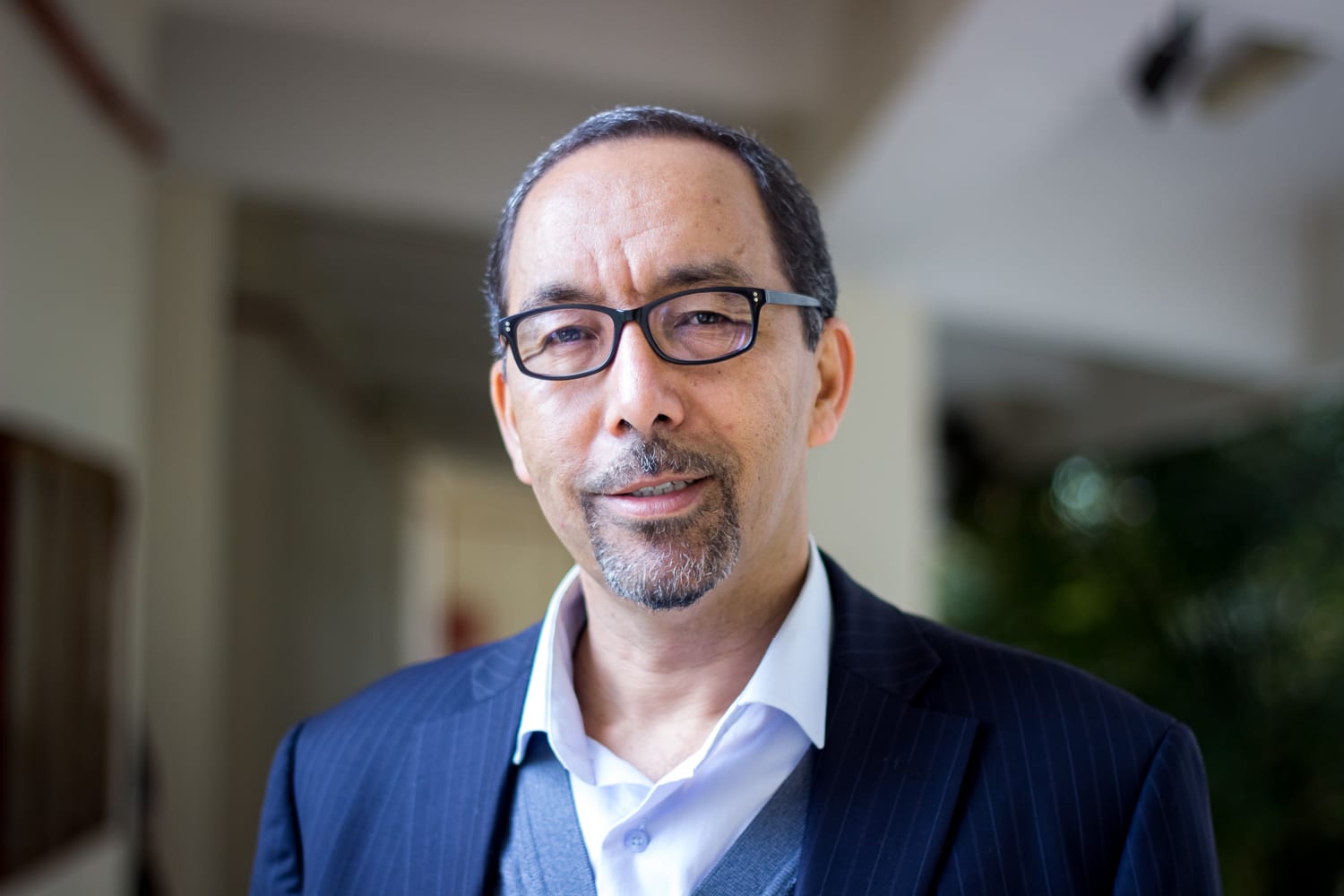
As Artificial Intelligence and Large Language Models (LLMs) rapidly reshape global educational paradigms, higher education stands at a transformative inflection point. This plenary presentation explores how LLMs can revitalize education in Algeria, not by automating or replacing educators, but by fundamentally redefining the teacher’s role—transitioning from traditional information transmission to active pedagogical design, mentorship, and critical thinking facilitation.
The presentation begins by examining the core capabilities of AI in education, including personalized learning paths, intelligent tutoring systems, adaptive assessments, and scalable exercise generation. While LLMs excel at instant feedback, administrative streamlining, and customized practice, they remain inherently limited; they cannot replace the irreplaceable human core of teaching, such as emotional intelligence, trust-based mentorship, contextual judgment, and classroom social dynamics.
Bridging global technological possibilities with local reality, the talk confronts systemic weaknesses currently hindering Algeria’s educational ecosystem. These include an over-reliance on traditional rote learning, rigid assessment frameworks, digital resource scarcity, and infrastructure bottlenecks. Addressing these gaps requires a candid assessment of the current state of education to ensure that technology adoption targets structural bottlenecks rather than superficial digitization.
To demonstrate concrete implementation, the presentation highlights practical hands-on experiences from teaching Natural Language Processing (NLP) at the Higher National School of Artificial Intelligence (ENSIA). It details course organization, pedagogical objectives, and innovative student team projects that leveraged LLMs to build education-focused applications, spanning intelligent chatbots, sentiment analysis, information retrieval, generative AI tools, and specialized Arabic language processing.
Finally, the talk outlines a strategic roadmap for AI integration in Algeria, addressing critical prerequisites such as technological infrastructure, comprehensive teacher upskilling, ethical AI frameworks, and linguistic adaptation. The session concludes with actionable reflections on the collective responsibilities of academic leaders, educators, and policy makers in establishing a sustainable, human-centered, AI-empowered educational model in Algeria.
Ambient AI promises a discreet symbiosis between humans and machines, but it stumbles on the rigidity of systems in the face of the diversity and unpredictability of real-world environments. To become truly ambient, AI must be flexible, adaptive, contextual, and multitasking — four pillars that allow it to change strategies, continuously adjust, read its environment, and combine multiple objectives.
This versatility relies on the ability to cope with the reality of data, as perfect data does not exist: noise, heterogeneity, inconsistencies, imbalances — AI must thrive in imperfection. The scarcity of data, common in fields like medicine or industry, necessitates reducing dependence on large volumes: few-shot learning extracts the essentials from a few examples, while meta-learning capitalizes on past experiences to accelerate learning. At the same time, the immense amount of available unlabeled data becomes a valuable resource thanks to self-supervised learning, which builds rich representations without the need for costly labeling.
The major innovation lies in the dynamic orchestration of these paradigms: the AI detects whether the data is abundant or scarce, reliable or noisy, labeled or unlabeled, and selects the most suitable strategy. It adjusts its internal representations in real-time according to the required task, leveraging multi-tasking to transfer knowledge between objectives, while relying on representation learning to extract abstract and generic features, thereby promoting more robust generalization. The AI then becomes a system aware of its own limitations — capable of quantifying its uncertainty, signaling a lack of data, or recognizing that a task is beyond its scope.
These new paradigms are transforming entire sectors: personalized medicine with limited clinical data, Industry 4.0 facing variations, education tailored to each learner, and even the analysis of unstructured data. The ambient AI of tomorrow will not be the one that has all the perfect data, but the one that knows how to make the best use of what it has—whether abundant or rare, labeled or unlabeled, imperfect or heterogeneous—for the task that matters, in the context that is ours.
Chair: Dr. Mohamed El Hadi Rahmani (University of Saida). The organizing committee brings together academics and staff from the University of Saida and the University of Naâma.
97 members from Algerian universities.
Big Data, data mining, information retrieval.
Frameworks, connectivity, security, AI in IoT.
Medical informatics, 3D imaging, green tech, networking.
Students: 3 000 Da
Lecturers: 5 000 Da
Other Participants: 10 000 Da
University of Saida Dr Moulay Tahar.
The Microsoft CMT service manages peer review - provided free by Microsoft.